Showing posts with label NATO. Show all posts

Monday, April 7, 2014

Missed by the Mainstream: Observations on the Ukraine Crisis


[The following is a somewhat revised version of a piece that first appeared on the Solidarity Webzine site on April 3, 2014 -AR]


A great deal has been written regarding the Ukraine events of February and March leading to the overthrow of Viktor Yanukovych. In their attempts to explain the upheaval, most of those weighing in have primarily focused on the internal dynamics - the domestic political terrain, the east/west ethnic divides, some inchoate desire to join the EU and “the West,” the influence of organized fascists, and  the corrupt and oligarchical nature of the ousted leader. 

Vladimir Putin
With Yanukovych ousted, the ever myopic US press rapidly shifted its attention to Russia’s response, or more accurately to the behavior of Vladimir Putin.  Dutifully describing the Russian moves in the Crimea as an outright “invasion” or “act of aggression” in violation of international norms and sovereignty, mainstream commentators resorted to to-be-expected simplistic explanations focused primarily on Putin. All context and understanding of even the very recent history disappeared, only to be replaced by facile talk of a “new Cold War” and “good” versus “evil” framings.

So how do we begin to decipher recent developments?

Ukraine currently straddles a complex fault line on the tectonic plates of Russian and US imperial concerns — geo-strategic, energy-related and economic. Numerous forces and competing interests, in play well before the demonstrations in Kiev’s Maidan, led to the recent seismic tremors along that geopolitical fault.

Through February and into March, all the “news” networks parroted the line that the protests in Kiev were solely the result of Yanukovych’s refusal of an offer to join the EU, rather than the “conditionalities,” the strings attached to the $15 billion financial assistance package. Rejecting what turned out to be “an offer he couldn’t refuse,” the Ukraine leader pivoted instead toward a Moscow “bail out,” actually an extended credit line free of EU-style “economic reform” demands. Casting the regime as nothing more than a clique of kleptocratic oligarchs, and the opposition gathered at the Maidan as an indistinguishable mass yearning for EU inclusion as the road to “freedom,” the dominant media disregarded some essential contemporary history.

Breadbasket cum Basket Case

Once the “breadbasket of Europe,” Ukraine has been an economic basket case pretty much since the implosion and 1991 dissolution of the Soviet Union. Privatization of what were formerly socialized assets and the handing over of key economic sectors, technically still state owned, to politically connected insiders, left whole segments of the society exposed and dispossessed. That system, rife with graft, “grey market” corruption mafia-like patron-client politics and rival political clans, gave rise to competing sets of oligarchs, many of whom remain at the “commanding heights.” 

Transparency International in 2013 listed Ukraine as the most corrupt country in Europe, tying globally with Cameroon, Nigeria, Iran and the Central African Republic. The Ukrainian shadow economy is one of the biggest in the world—at around 50% of GDP, according to the IMF, and Ukraine’s new prime minister early in March estimated that $37 billion had gone missing during Yanukovych’s time at the top. (It should be noted that many of Yanukovich’s Party of Regions colleagues, not to be left out in any reshuffle, distanced themselves from their former leader.) 

The plight of the popular classes had been worsening for some time as their purchasing power and  standard of living continued to decline. Following a deplorable situation throughout the 1990s, per capita income improved somewhat, but fell precipitously following the “Orange Revolution” of 2004-05. Then came the global downturn of 2008. 

The “Great Recession,” from which the Ukraine economy has never recovered, dried up credit and investment from abroad, raised the price on imports, slowed exports, depleted the country’s hard currency reserves, increased the national debt, and resulted more recently in the devaluation of the nation’s currency by 20% in relation to the dollar. All segments of the society — the under- and unemployed, the youth, pensioners, and working class families — experienced diminished buying power. All, that is, except the nouveau riche robber barons and politicos at the top or those somehow connected to them.

Clearly, it was the worsening conditions in the country, compounded by graft and political corruption at all levels but especially by the unregulated piratical capitalists at the helm, that fueled the discontent leading up to Maidan. The mass demonstrations and the state’s tough response to the protests, in turn, opened the door for parties and organized formations of ultra-nationalists able to inflame the deteriorating situation on the ground and thereby veto any resolution of the crisis short of Yanukovych’s ouster and a changing of the oligarchic guard. 

“Shock Therapy”?

It must be understood, as well, that the IMF had a hand in creating the volatile situation. (One could construct an argument, based upon a close reading of the record, that the aim of its strategy all along was to draw the country into the Western orbit.)

In the country since the early 1990s, in October 2008 the IMF granted Ukraine a $16.4 billion loan to be doled out over period of years. It froze installments in late 2009 after Ukraine raised minimum wages and pensions in violation to IMF “conditionalities”. 

In late July 2010, the financial consortium approved another 29-month $15.15 billion loan, conditioned on putting an end to long-established consumer price subsidies for natural gas. (The government, incidentally, had been charging consumers a quarter of the price being payed to providers, primarily Russia’s Gazprom.) The country’s trade unions warned at the time that resulting 50 percent increases on household gas utility prices would “stoke social unrest and uncontrolled inflation.”

According to the since deposed Ukrainian Prime Minister Mykola Azarov, it was "the extremely harsh conditions" of a renewed November, 2013 IMF loan offer that set the stage for the Yanukovych government's decision to put off signing an the “Association Agreement” between Ukraine and the European Union. The November turn away from the EU became a catalyst for the Maidan protests.

“It’s the Energy, Stupid…”

While some have described the heightened tensions over Ukraine as the possible beginning of a “new Cold War”, the dispute may best be understood as but one salvo of what Michael Klare writing on the geopolitics of energy, has described as a globally intensifying “race for what’s left” -- or,more accurately, the increasing major power and corporate competition over all aspects of the production and distribution of plentiful energy sources. 

That heightening international scramble for control of the world’s vital resources, essential among them the hydrocarbon fuels vital for the operation and stability of the world's major economies, provides an important backdrop for the Ukraine events.  

Not to be overlooked, “energy security” has moved to the fore as a central strategic concern, not just of the major multi-national energy corporations - Exxon Mobil and the rest - but for capitalist state and private sector planners, and development strategists at the IMF, the World Bank and other IFIs. Innumerable think tanks and NGOs, and of course, the military, industrial and intelligence establishments of all the major powers, The US and Russia first and foremost among them, are all now deeply invested in the race. 

In the particular scramble for control of oil and, increasingly, natural gas, the major capitalist states and corporations have sought to influence those regimes sitting atop known reserves and as of yet untapped sources of hydrocarbon wealth, whether in the Middle East, Central Asia, or elsewhere. In addition, a number of countries with pipelines or ports, key transit and distribution points, have acquired increased in “strategic value” as the rush for “black gold,” gas and other strategic minerals (notably coal, uranium, and gold) continues to intensify.

Russia is a gas and oil rich hydrocarbon state. A high percentage of its recent development and relative prosperity has been fueled by the high price of gas and oil exported to energy dependent Central and Eastern Europe, and more recently India and China. The country’s development, hampered by the decline in energy prices following the 2008 global slowdown, has benefitted more recently from the rebound in international demand.

Russian exports currently account for nearly a third of European gas imports. Upwards of 80 per cent of that supply has flowed through Ukraine enroute to other Eastern European states and points West. As of 2009, two-thirds of annual revenue of Russia’s state-owned Gazprom came from the sale of gas transiting through Ukraine.

Gas lines transiting through Ukraine

Ukraine, itself, has been dependent on those same gas lines for upwards of 60 percent of its domestic needs. Russia has consistently sold that gas to Naftogaz, Ukraine’s national gas company at subsidized prices, up to 30 percent below the international market price, as part of the transit agreements. Fuel has also been handled by opaque, for profit go-between firms, apparently serving no other purpose than to skim off earnings through speculation and gray market trading.

Despite favorable conditions, Kiev has consistently been unable to pay its gas bill, in part because of the general state of its economy, but also because of the billions of dollars siphoned off annually by well-connected kleptocrats lording over the energy sector, at times in collusion with their Russian counterparts. In 2006, Russia cut off the flow after it determined that the state owned gas company, Naftogaz, had been diverting Europe-bound supplies to domestic use. 

Due to unpaid gas bills, Russia again cut off the country’s flow during January, 2009. In response, Ukraine again drew supplies for domestic consumption from the European stream. That, in turn led to severe fuel shortages or diminished supplies in a total of eighteen countries, among them Poland, Hungary, the Czech Republic, Greece, Austria and Germany. 

That month-long situation sent serious signals to the EU, its members still unevenly caught in the vice grips of the “Great Recession.” The immediate Russo-Ukraine crisis then subsided as Kiev borrowed the money to start paying what it owed (by borrowing from Russian banks!) and the “special relationship” resumed, built upon a mounting Ukranian debt owed Gazprom and other creditors. 

Partly in response to that vulnerable situation but also as part of a broader strategy already long underway, US and EU state strategists, IFIs, allied energy company “majors,” and mega construction firms accelerated plans for various east-west gas line projects extending from as far away as Azerbaijan and Kazakhstan in Central Asia. Carried on in cooperation with numerous regimes of Russia’s “near abroad,” those projects have been consciously planned, in part, to wean Central and Eastern Europe away from a dependency on Russian energy. 

Ukraine took its first major step away from dependency on Russian gas imports when it signed a $10 billion shale gas deal with Royal Dutch Shell in mid-January 2013. That 50-year production sharing agreement at the time marked the biggest contract yet to tap shale gas in Europe and the largest direct foreign investment in the former Soviet republic.
(Partly out its own concern over the unreliability of Ukrainain and other Eastern European transit routes, Russia’s Gasprom in turn has proceeded with the construction of its “Nord Stream” gas pipeline running under the Baltic Sea from Russia to Germany. With Gazprom holding a 51 percent interest, the Swiss-headquartered joint stock company heading up the project, Nord Stream AG, is comprised of a number of Western European energy and construction companies as well as German, French and Russian investment banks.)
As energy politics journalist Steve Horn has shown, amidst all the hubbub regarding the Maidan demonstrations, the Kiev coup, and subsequent Russian response in the Crimea, multibillion dollar joint shale gas exploration ventures between Exxon-Mobil and other energy “majors” and the Russia’s Gazprom and oil giant Rosneft have continued full bore in Siberia, the Gulf of Mexico and yes, the Black Sea off Crimea, unimpeded by limited Washington sanctions.

To NATO or not to NATO…

While barely scratching the economic undercurrents of the Ukraine story, mainstream Western media have consistently given short shrift to any possibly legitimate Russian concerns. Key among them, certainly from Moscow’s perspective, has been the eastward march of NATO, understood primarily as a US led military alliance. 

Founded in 1949 for the “collective defense” of Western Europe against improbable “Soviet aggression”, the alliance in the Russian view has always been a US-led offensive force. (The Soviet bloc’s mutual defense Warsaw Pact came about in 1955, well after NATO’s formation.) 

As the Cold War came to end, Germany reunified in 1990, making the former East Germany an ipso facto part of NATO. In exchange for his assent to the reunification, Mikhail Gorbachev received a US promise from then US Secretary of State, James Baker that the alliance would expand “not one inch to the east”. 

In 1999, Poland, Hungary, and the Czech Republic joined the organization, despite Russian opposition. Expansion continued as seven Central and Eastern European countries — Estonia, Latvia, Lithuania, Slovenia, Slovakia, Bulgaria, and Romania — were integrated into the organization in March 2004. Albania and Croatia joined in April 2009, while Bosnia and Herzegovina, Montenegro, and Georgia have the stated goal of eventually joining.


(Source: Agence France Press, 2008)

In addition, virtually all the former Soviet republics now have some form of bilateral military cooperation with the Organization, under its Partnership for Peace(PfP) program. Ukraine became the first former Soviet republic to join the PfP initiative in February 2005, after deepening its ties through a November, 2002 “NATO-Ukraine Action Plan”. It soon entered into the “Intensified Dialogue” program with NATO.

In March 2008, under then President Viktor Yushchenko and his Prime Minister Yulia Tymoshenko, Ukraine sent an official letter of application for a Membership Action Plan (MAP), the first step in joining NATO. Facing objections from his opposition, Yuschenko at the time guaranteed that membership in any military alliance would not take place without a public referendum. Russian leaders at the time made clear their opposition to Ukraine membership. 


Yushchenko at NATO, 2008
At the 2008 NATO summit in Bucharest, to which Vladimir Putin was invited, he listed his Russia’s grievances with NATO, among them deployment of a “defensive missile shield” on the country’s western frontier. He at the time called Ukrainian membership "a direct threat" to his country. The then NATO Secretary General nevertheless declared shortly afterward that Ukraine, along with Georgia, would someday join the alliance, but that their respective MAPs were deferred to some later date.

According to numerous independent polls conducted since 2002, Ukrainian public opinion on NATO membership was split, with the majority of those polled generally opposed to joining the alliance. A Pew Research Center poll in March 2010 showed that opposition was particularly high, at 74%, among ethnic Russians while earlier polls among the entire population reflected general disfavor.  

The 2010 election returned Yanukovych as President and marked a turnaround in Ukraine's relations with NATO. In February 2010, he stated that there was "no question of Ukraine joining NATO” and later that year announced that Ukraine would remain a "European, non-aligned state.” 

On June 3, 2010 the Ukrainian Rada rejected the goal of "integration into Euro-Atlantic security and NATO membership" as part of the country's national security strategy. The enactment forbade Ukraine's membership in any military bloc, but allowed for bilateral co-operation.

Yanukovych’s February ouster signaled a possible change back in the direction of at least western Ukraine's association with the EU, and by extension NATO. Russia’s annexation of Crimea reshaped the political terrain even further, however.

The US-favored, newly-installed Prime Minister Arseniy Yatsenyuk, in an apparent attempt to assuage Russian concerns, on March 18 stated that Ukraine was not seeking NATO membership. U.S. President Barack Obama echoed that position a week later, while nevertheless calling for a greater NATO presence in Eastern Europe. But NATO head Anders Fogh Rasmussen stated afterwards that Ukraine membership was still an option.

Writing in the Nation on February 11, noted Russia scholar Stephen Cohen stated that the “most crucial media omission” in all the mainstream analyses of the recent situation had been “Moscow’s reasonable conviction that the struggle for Ukraine [was] yet another chapter in the West’s ongoing, US-led march toward post-Soviet Russia.” 

Cohen went on to note the following: “Whether this longstanding Washington-Brussels policy is wise or reckless, it—not Putin’s December financial offer to save Ukraine’s collapsing economy—is deceitful. The EU’s ‘civilizational’ proposal, for example, includes ‘security policy’ provisions, almost never reported, that would apparently subordinate Ukraine to NATO. 

Vilified in conservative quarters as a Russian dupe for his utterances, Cohen dared to point out that that encroachment began in the 1990s, despite the Gobachev-era US agreement to hold the line NATO eastward movement. Russia’s civilian leadership and national security apparatus, witnessing that US-led “Drang nach Osten” and not about to imperil its warm-water Black Sea port at Sevastopol, drew a line in the sand of the Crimean peninsula.

Then again, Russian perceptions regarding conceivable threats from “the West” and encroachments into its sphere of influence, especially in what it considers its “near abroad,” may just be a bit paranoiac. After all, there really hasn’t been much of a military threat from the west for some time. Not since Napoleon marched on Moscow. (That is, if one were to overlook the First and Second World Wars!)

“I’ve Seen the Future, Brother… It Is Murder”?

Ukraine’s woes will continue to deepen. The country currently owes Russia billions for its gas bill and has a national debt equaling at least 40 percent of its GDP, and Russia immediately canceled its long standing discount on gas prices following Yanukovych’s ouster. If internal social and political turmoil and tensions with Russia continue to mount, the situation in the country could deteriorate further as a significant portion of its industrial capacity is located in the east; in areas with a higher percentage of ethnic Russians, more favorable to Russian advances. 

As a result, living conditions of its subordinate classes are not likely to improve and will more than likely deteriorate further as projected EU and IMF assistance will not come without deepened “economic reform” austerity demands. A mere $1 billion in US aid will barely matter. (An amount far exceeding that annually gets paid out in bribes in the country!)

The country certainly is not about to become some liberal capitalist democracy. Certainly not as long as the state and the economy are dominated by bands of oligarchs and certainly not as long as Svoboda and Right Sektor members head key domestic ministries and their militants rule the streets. 

A rapacious primitive accumulation will continue unabated in the meantime, while much of the nation’s dwindling wealth finds its way to IFI ledgers and sheltered accounts in “the West”. The situation will continue to deteriorate for Ukraine's popular classes despite the feeble sanctions and posturing of the US and its erstwhile allies, feigning indignation over Russia’s real politik  assertions of its own national interests.


Wednesday, January 9, 2013

Why Progressives Should Oppose Hagel


[An initial version of this piece appeared on The Progressive Magazine's webzine on Jan. 7th]

Chair of the Atlantic Council  Chuck Hagel to head Pentagon?
Following weeks of trial balloon conjecture, White House point men announced over the weekend that President Obama would nominate Chuck Hagel, the former Senator from Nebraska and oft-described “moderate Republican,” to succeed Leon Panetta as Secretary of Defense.

Conservative critics immediately raised objections as soon as Hagel’s name surfaced as a probable nominee in mid November. The usual pack of Neocon watchdogs charged him with being inadequately hawkish on Iran and out of lock-step in requisite full support for Israel.

Towing its increasingly neocon editorial line, the Washington Post on November 18th editorialized that Hagel wasnot the right choice for defense secretary.” Citing the ex-Senator-cum-Washington insider’s public record, the WAPO suggested that, “Mr. Hagel’s stated positions on critical issues, ranging from defense spending to Iran, fall well to the left of those pursued by Mr. Obama during his first term.” (Hagel once had the temerity to suggest that Pentagon spending should be “pared down.” Imagine!). 

Detractors dredged up a back-when Senate vote against Iran sanctions as right-wing media hacks echo chambered alleged “anti-Semitism” based upon the Senator’s years ago use of the phrase “Jewish lobby”. He certainly rankled some Israel right-or-wrong types in 2006 when he said, “I’m not an Israeli senator. I’m a United States senator. I support Israel, but my first interest is I take an oath of office to the Constitution of the United States, not to a president, not to a party, not to Israel. If I go run for Senate in Israel, I’ll do that.”

Liberal backers, in response, immediately sprung to the Nebraskan’s defense. The Atlantic’s James Fallows described him as a “wise bipartisan pick” with Vietnam combat-vet cred and a “cautious realist-centrist record” while filleting the “bogus case against Chuck Hagel.”

Hagel in August, 2005 had won favor among centrist types when he became the first Republican Senator to publicly criticize the Iraq war and to call for US withdrawal. Criticizing then President Bush, the GOP, and the Patriot Act's erosion of civil liberties that December, Hagel stated that, "I took an oath of office to the Constitution, I didn't take an oath of office to my party or my president," He later went on, in 2007, to criticize plans for the Iraq war “surge”. Such rank-breaking statements, while endearing him to disquieted anti-war moderates have never been forgotten by the Right.

The problem today is that neither Hagel’s detractors nor his supporters have really fully laid out who he is or why progressives should firmly oppose his appointment as the Pentagon’s top gun. Certainly, those to the left should not fall into the trap of cheering on Obama’s latest War Department pick, solely because the Right stands opposed.

Currently a member of the board of directors of Chevron, Hagel led the charge in 1997 to block ratification of the Kyoto Protocol, the international agreement that would have committed the US and other industrial nations to reducing greenhouse gas emissions. The Hagel-Byrd Resolution, co-authored by  the coal friendly Democrat and “conscience of the Senate,” West Virginia’s Robert Byrd, argued that the Kyoto failed to include developing countries and posed barriers to US economic expansion.

On his way through the revolving door to higher fame and fortune, Hagel announced in September, 2007, that he would not seek a third term in the Senate. While his current mainstream biographies note that he happens to teach at Georgetown, they somehow consistently miss mentioning that he might have to give up his current position on Chevron’s board. 

He probably will have to rotate out of his seat as co-chair of the President’s Intelligence Advisory Board, the appointed body of distinguished citizens selected from the national security, political, academic, and private sectors…, independent of the Intelligence Community, free from day-to-day management or operational responsibilities.., with full access to the complete range of intelligence-related information.”

Hagel also currently sits on the board of directors of the American Security Project, a Washington-based imperial think tank committed to “understanding and articulating American beliefs and values related to U.S. foreign policy,” and forging a domestic “bipartisan consensus” on “a new national security strategy that will restore America’s leadership…”  Founded in 2007, with Hagel and Hillary Clinton’s State Department heir apparent, John Kerry as founding members, the ASP is heavily involved in “energy security policy research,” and “the national security need for biofuels” (i.e., the “greening” of the Pentagon) as well as “cultivating strategic responses to 21st century challenges.”

If he receives Senate confirmation, Hagel’s current position as Chair of the non-governmental but immensely influential Atlantic Council will most likely be placed on hold, at least until he returns to “private life.”

Seldom discussed, the Washington-based Council was founded 50 years ago as an elite foreign policy NGO committed to forwarding US “national interest” and continued Cold War supremacy within the “Atlantic community” and beyond. According to foreign policy critic Rick Rozoff, it was established in 1961 by former Secretaries of State Dean Acheson and Christian Herter to bolster support for NATO. Under US leadership, Atlantic Councils were set up in affiliated member states for the same purpose.

A recent list of Council associates reads like a “who’s who” of the Washington foreign policy establishment. Henry Kissinger’s disciple, the former National Security adviser Brent Scowcroft has played a significant role in shaping the contemporary organization.  Obama’s first National Security Advisor James L. Jones and UN Ambassador Susan Rice, the first pick to succeed Panetta at the Pentagon, formerly worked for the Council.

Hagel’s predecessor as Council Chair, Jones had been a Marine Corps four-star general, top commander of U.S. European Command and NATO Supreme Allied Commander Europe from 2003 to 2006. He also served as Secretary of State Condoleezza Rice’s special envoy for Middle East security and in that position openly discussed deploying NATO troops to the West Bank, a recommendation echoed by his Atlantic Council colleague, Scowcroft.

Scowcroft, a retired Air Force general and National Security Advisor under Presidents Ford and George H. W. Bush, is now the chairman of the Atlantic Council’s International Advisory Board.

Co-chaired by Hagel, the Council’s Strategic Advisors Group is a standing body of roughly 40 senior experts on NATO and transatlantic security issues. Founded in 2007 by then Council Chairman Jones, Scowcroft, and others, the SAG describes itself as the “pre-eminent institution for strategic thinking and analysis on Euro-Atlantic security” through its “thought leadership” on issues such as Afghanistan/Pakistan, and NATO’s Strategic Concept. 

The SAG produces major public policy briefs and reports, and hosts off-the-record “Strategy Sessions” for senior U.S. and European civilian and military officials, while providing “informal, expert advice to senior policymakers.”

With Chuck Hagel at the helm, the Council’s attentions have increasingly turned toward Central and South Asia. As part of that pivot, especially toward oil and uranium rich and strategically located Kazakhstan, the Council undertook a project in 2010 entitled Eurasia as Part of Transatlantic Security’. Also headed by Hagel, that effort has sought to “shape the transatlantic debate on security in Eurasia…”  

The Council’s Eurasia Task Force has been funded by a grant from the Kazakhstan government, currently ruled by the authoritarian “president for life,” Nursultan Nazarbayev. Additional support has come though the Council’s Strategic Advisory Group as well as from EADS-North America, the US subsidiary of one Europe’s largest military aircraft manufacturers presently providing weaponry to repressive regimes across Central Asia.

While still in elected office and well before he joined the BOD at Chevron (today a major investor in Kazakhstan’s Caspian Sea oil fields) or became Chair of the Atlantic Council, Hagel had been the only US Senator to visit all five Central Asian republics.  His dovetailing interests and ties to the region have continued since.

In May, 2010 Michele Kinman, the deputy director of Crude Accountabilty, an environmental citizen action group concerned with Caspian Sea regional issues,  addressed Hagel at Chevron’s annual Board of Directors’ meeting.

Kinman pointed out how Chevron was intensely involved in hydrocarbon projects in Kazakhstan fraught with violations of environmental law, a lack of transparency and, ultimately, scandal.

She pointed out how Chevron was then poised to sign a major agreement with the authoritarian government of Turkmenistan to develop the country’s largely untapped hydrocarbon reserves.  Noting Hagel’s clear interest in and ties to Caspian oil and gas development, she also pointed to his stated record in support of transparency and anti-corruption.

She called upon him to be put his weight behind a call for Turkmenistan, one of the world’s most repressive countries, to “dramatically and measurably improve its human rights and accountability record before Chevron invests in its hydrocarbon sector.”

Kinman went on to argue that, “If Chevron engages with a repressive regime such as Turkmenistan to secure hydrocarbons without first insisting on significant, demonstrable improvements in human rights, transparency and rule of law, it will strengthen anti-democratic tendencies and stifle the development of an already severely compromised civil society, as it has in Burma, Nigeria, Columbia and in numerous other countries around the world.”

Addressing the now would-be Secretary of Defense, she went on: “Senator Hagel, as a new board member, you have a tremendous opportunity and responsibility to raise the bar for corporate responsibility in the Caspian to a level that is in accordance with the Chevron Way, for starters, but more importantly, in accordance with international law and practice.”

“Senator Hagel,” she asked, “Are you prepared to insist that your company take a principled stance in favor of human rights in Turkmenistan today?”

Hagel did not respond to Kinman. Instead, Chevron CEO John Watson encouraged Crude Accountability to write the Senator at a later time.

Perhaps during his confirmation hearings, some current Senator will elicit some answers to similar questions as Kinsman’s regarding Hagel’s concerns for “energy security” and a his apparent willingness to overlook the nature of repressive regimes in exchange for such.  The prospect is unlikely.


Friday, March 16, 2012

Massacre in Kazakhstan: Killing Hope for US Interests

Steve Horn & Allen Ruff*

December 16, 2011, should have been, at minimum, a fairly bright day for the people of Kazakhstan marking the country's Independence Day and 20th birthday.

But rather than being a moment of celebration, it became a day of brutal repression and death, a bloody scene in the regional center of Zhanaozen paralleling those that occurred at the hands of US-supported dictatorial regimes during the uprisings now commonly referred to as the Arab Spring.

The victims of the state's crackdown were striking oil workers protesting subsistence wages and poor working conditions in the city of 51,000 citizens 75 miles east of the Caspian Sea.

Kazakhstan's state media reported police shot and killed ten workers, wounding more than 80 strikers. 

Independent journalist Mark Ames translated an account of a Russian reporter who estimated approximately 70 dead, with 500 to 800 wounded. Scores more were jailed, likely the victims of beatings and torture.

Following the shootings and arrests, Zhanaozen, home to the state-owned oil company, KazMunaiGas (KMG), was placed under a state of emergency. Authorities cut off Internet and communications access nationwide and the city was inundated with additional thousands of police. KMG has ongoing business ownership partnerships with the US-based multinational energy giants Chevron and ExxonMobil, which hold significant concessions in the country.

EurasiaNet's Joshua Kucera reported the attacks on the strikers were carried out by police armed with US-supplied weaponry. Some of the 114 Humvees given to Kazkahstan since 2002 as part of the US-funded  Kazakhstan Peacekeeping Brigade (KAZBRIG) were filmed on the streets during the height of the repression.

That same cold, dark December day at Aktau, 75 miles to the west, police cracked down on rallies held in solidarity with the Zhanaozen workers. Human Rights Watch documented that, "police detained about 100 protesters and took them to a temporary detention center ... Workers in Aktau reported heavy police surveillance at the protest, which was held in front of the regional mayor's office."

Human Rights Watch responded to the abuse of civil liberties by calling for an investigation into the use of state violence and called for the restoration of telecommunications services.

Nursultan Nazarbayev
The repression was conducted by a police apparatus built up under the dictatorial reign of President Nursultan Nazarbayev, the country's leader and "winner" of fixed election after election since the Central Asian Republic became independent following the break-up of the Soviet Union in 1991.

Later, parliamentary elections took place on January 15, with Nazarbayev initially barring those living in Zhanaozen from participating. He later revoked that decision, but that didn't matter, since the elections are consistently rigged to begin with under what is essentially a one-party state.

The December repression of oil workers, and the political situation at large in Kazakhstan, call for a deeper examination into the geopolitical situation of a country located at the heart of what has long been referred to as the historic Silk Road trade route and what investigative journalist Pepe Escobar refers to as Pipelineistan.

Four times the size of Texas and larger than western Europe, a massive country of over 16 million at the heart of Central Asia, resource-rich Kazakhstan has increasingly become a vital centerpiece of US strategic interest, "soft power" and "hard power" regional influence.

The country has become case study for US deployment of the so-called "three D's": diplomacy, development and defense - as part of the broader ongoing long-war effort delineated in the Pentagon's April 2011 National Strategic Narrative and elsewhere. 

Northern Distribution Network: "A Modern Silk Road"

Kazakhstan sits close to the path formerly known as the Silk Road, an overland caravan trade route traversing the region linking China to the Middle East. A similar route, carrying weapons and key equipment to Western occupation forces in Afghanistan, is now referred to by US strategic planners as the Northern Distribution Network (NDN).

CNN describes the NDN's path this way: "The main route begins at the port of Riga in Latvia, from where freight trains roll across Russia, and continues along the edge of the Caspian Sea. It crosses the deserts of Kazakhstan and into Uzbekistan.... Other routes begin at the port of Ponti in Georgia on the Black Sea and at Vladivostok in the Russian Far East."

The Center for Strategic and International Studies, a conservative think-tank, wrote a report published in December 2009 that described the NDN as the "modern silk road."

CNN explained what was carried on this new Silk Road: "About 10 days after beginning their odyssey, the containers cross into Afghanistan, carrying everything from computers and socks to toilet paper and bottled water."

The Pentagon announced the NDN on January 20, 2009, the same day as President Barack Obama's inauguration. At the end of 2009, in December, Obama announced the "surge" in Afghanistan, to the shock and awe of some. But close observers, aware of the new president's previously announced intentions, and aware of behind-the-scenes developments like the NDN, found the announced escalation far from surprising.

With the overland Khyber Pass supply route from Pakistan to southern Afghanistan regularly threatened and periodically closed by Taliban attacks, and US-Pakistan relations becoming increasingly sour - due, in large part, to Obama's drone war being waged in Pakistan - the NDN has only grown in importance over time.

"The Grand Chessboard"

The ninth-largest country in the world, Kazakhstan borders the Caspian Sea and Turkmenistan in the southwest, Uzbekistan and Kyrgyzstan to the south, China to the East and Russia to the north. The country is also fairly close to key centers of current US geopolitical concern: Iran and Afghanistan. The broader region is also of vital geostrategic importance for its great-power neighbors - Russia and China.
In addition to Kazakhstan's geostrategic importance, the Caspian Sea, which it borders, holds over 4 billion tons of proven recoverable oil reserves and 3 trillion cubic meters of natural gas, according to the CIA World Factbook.

Zbig Brzezinski & the Grand Chessboard: Still pondering after all these years.

In his 1997 work on US geopolitical strategy, "The Grand Chessboard," Jimmy Carter's former national security adviser, Zbigniew Brzezinski explained the importance of the "Eurasian core," which has Kazakhstan at its center:
For America, the chief geopolitical prize is Eurasia.... America's global primacy is directly dependent on how long and how effectively its preponderance on the Eurasian continent is sustained.... Eurasia is the globe's largest continent and ... [a] power that dominates Eurasia would control two of the world's three most advanced and economically productive regions.
Brzezinski explained that the area is far too large to control through direct rule alone and alluded to the projection of what is now referred to as US "soft power" as part of the "great game": 
That mega continent is just too large, too populous, culturally too varied, and composed of too many historically ambitious and politically energetic states to be compliant toward even the most economically successful and politically preeminent global power. This condition places a premium on geostrategic skill, on the careful, selective, and very deliberate deployment of America's resources on the huge Eurasian chessboard.
US soft power, inspired by the academic work of Brzezinski, would eventually be projected in Kazakhstan in the form of diplomatic efforts and development programs under the auspices of the United States Agency for International Development (USAID), the Peace Corps, educational endeavors like the Bolashak Program, and American Corners, as well as assistance in the creation of Nazarbayev University at the nation's new capital, Astana.

US hard power would also soon be projected into Kazakhstan, including the provision of weapons for the Kazakh military and police; unmanned aerial vehicles (UAVs), more commonly known as drones; construction of strategic military bases in neighboring countries; the contracting out of private mercenary forces placed in the region; and the training of the Kazakh military and policing force.

The Three D's: The US-Kazakh Chessboard

Heeding Brzezinski's "Grand Chessboard" advice, US foreign policy efforts toward Kazakhstan have centered less around defense and more on development and diplomacy.
Given that caveat, there has been no shortage of US-provided "defense" for Kazakhstan and the countries surrounding the Caspian when Washington's grand strategists have called for it.

"Defense"

According to USAID figures, the US doled out $17.8 million in military aid to Kazakhstan between 2006 and 2009. While a seemingly paltry sum when compared to that bestowed upon major recipients such as Israel and Egypt, such assistance has played a significant role in solidifying the relationship with the Nazabayev regime.

An October 2009 State Department diplomatic cable released to the public by WikiLeaks showed that the United States provides UAVs, or drones, to the Kazakh military.

The Department of Defense (DoD), while it does not maintain any military bases in Kazakhstan, does maintain one in neighboring Kyrgyzstan, the Transit Center at Manas, formerly known as Manas Air Base. The DoD formerly maintained one in nearby Uzbekistan called the Karshi-Khanabad Air Base. Both bases were utilized by the US military during its ongoing occupation in Afghanistan.

The Transit Center at Manas, according to a November 2011 New York Times piece, is set to close shop in 2014, when the US lease with the Kyrgyz government expires. Washington currently pays $40 million per year to rent space at the air base, according to the Times.

In Kazakhstan, US-provided "defense" has gone far beyond the mere sale of weaponry and has entered into the sphere of operational support and training of the country's military. In 1995, the US Central Command (CENTCOM), through the National Guard State Partnership Program, initiated an exchange program between the Arizona National Guard and the Kazakh Armed Forces. The program aimed at "working towards expanding Kazakhstan's role in the [North Atlantic Treaty Organization (NATO)] Partnership for Peace program," explained former Clinton administration Secretary of Defense William Perry at a February 1996 press conference.

Another key collaboration between the US and Kazakh militaries has been the annual joint "Steppe Eagle Exercise." Under the umbrella of NATO, the program was inaugurated in 1997 as part of NATO's Partnership for Peace. Kazakhstan, a bit far from the Atlantic, joined NATO in 1995.
CENTCOM troops, as well as reservists from the Arizona and Colorado National Guard, participated in the 2011 exercise at Camp Illisky, Kazakhstan.

Steppe Eagle falls under the US military's broader Theatre Security Cooperation Program (TSCP), an initiative begun in 1995 which prepares US allied military forces for joint operations, according to an Army press release.

"Theater Security Cooperation (TSC) programs are the centerpiece of our efforts to promote security and stability by building and strengthening relationships with our allies and regional partners and are an indispensable component of our overarching ... strategy," Hamlin B. Tallent, director of the US European Command's (EUCOM) European Plans and Operations Center explained in a March 2005 statement before the US House International Relations Committee.

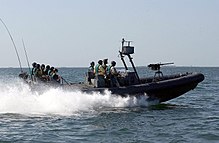
Participants in the 2004 Joint Civilian Orientation Conference take a ride in a US Navy special operations rigid inflatable boat during a visit to Baku, Azerbaijan
One of the most important pieces of the "defense" side of the "3- D's" equation is the CENTCOM-trained special operations force collaboration between Azerbaijan and Kazakhstan, known as the Caspian Guard Initiative, which got off the ground in fall 2003.

A 2005 article appearing in Agence France-Presse explained, "The United States plans to spend a total of 135 million dollars within the framework of the US-funded Caspian Guard Initiative, which envisions improving the capabilities of the maritime forces of Azerbaijan and Kazakhstan."

Investigative journalist Jeremy Scahill, in his book, "Blackwater: The Rise of the World's Most Powerful Mercenary Army," wrote that Blackwater USA, now known as Academi and, previously, as Xe Services, plays a key role in the Caspian Guard Initiative.

"Beginning in July 2004, Blackwater forces were contracted to work in the heart of the oil- and gas-rich Caspian Sea region, where they would quietly train a force modeled after the Navy SEALs and establish a base just north of the Iranian border," Scahill wrote.

"Blackwater would be tasked with establishing and training an elite ... force modeled after the U.S. Navy SEALs that would ultimately protect the interests of the United States and its allies in a hostile region ... [serving] a dual purpose: protecting the West's new profitable oil and gas exploitation in a region historically dominated by Russia and Iran, and possibly laying the groundwork for an important forward operating base in an attack against Iran," he continued.

Also falling under the umbrella of the Caspian Guard Initiative was a key provision of the 2006 National Defense Authorization Act (NDAA), Section 1206, which, according to a February 2011 report by the Congressional Research Service (CRS), "provides the Secretary of Defense with authority to train and equip foreign military forces for two specified purposes - counter-terrorism and stability operations - and foreign maritime security forces for counterterrorism operations."

Under Section 1206, Kazakhstan has, thus far, received $31.8 million for "Caspian Security" and "Counter-Terrorism and Stability Operations Capacity Aid," according to the CRS.

Kazakhstan, as a participant in the Global Peace Operations Initiative, a joint effort by the State Department and the DoD, also received "$14 million in funds ... [for] body armor, water purification units, vehicles, and uniform equipment" in 2006 and 2007, according to the Government Accountability Office (GAO).

"Development and Diplomacy"

What Brzezinski described as placing "a premium on geostrategic skill, on the careful, selective, and very deliberate deployment of America's resources on the huge Eurasian chessboard" has many important facets, but all center around creating a stable, market-based economy friendly to US corporate interests.

The most overt example of this includes oil giant Chevron's entry into Kazkahstan in the early 1990s. The energy giant secured a major stake in Kazakhstan's huge Tengiz oil field with the creation of a partnership, called Tengizchevroil, between Chevron, ExxonMobil, the Russian government-owned LukArco and the Kazakh government.

Railroad tanker cars wait on a siding in the Tengiz oil field in western Kazakhstan. (Photo: Viktor Korotayev / The New York Times)
Other examples of key business alliances include the American Chamber of Commerce in Kazakhstan, the US-Kazakhstan Business Association, the Chamber of Commerce and Industry of the Republic of Kazakhstan in the USA, and the US-Kazakhstan Public-Private Economic Partnership Initiative, to name several.

Corporations, though, need legitimation among the population in the various nation-states in which they are operating - in other words, various avenues of soft power projection. A WikiLeaks cable from November 2008, for example, stated that the United States was involved in a soft power "war of ideas" in Kazakhstan.

One significant US influence peddler has been the Peace Corps, which entered Kazakhstan in 1993, two years after the country gained independence from the USSR. As of July 2010, according to a Peace Corps document, over 1,000 volunteers had spent a 27-month sojourn in the country.

Peace Corps volunteers taught classes at American Corners centers located throughout Kazakhstan, described by the US Embassy in Kazakhstan as "small, American-style libraries located within a local partner organization, usually a library ... [which] support local English instruction with an extensive collection of English teaching materials which are frequently used by local students, teachers and US Peace Corps volunteers."

An abrupt and controversial end to the Peace Corps presence in Kazakhstan in November 2011 shed light on some of the darker aspects of Kazakh society. "This organization assists mainly in the least developed countries," the Peace Corps said in a statement. "Many programs of the Peace Corps in Kazakhstan, in general, have come to their conclusion," said the Kazkah Ministry of Education and Science in an article appearing in The Christian Science Monitor.

Several former Kazakhstan-based Peace Corps volunteers offered starkly different explanations for the pullout.

In her November 18, 2011 "Eulogy to Peace Corps Kazakhstan," Rebecca Gong, now a graduate student at Harvard, offered what she referred to as "a long-suppressed insider exposé of all the issues." Gong honed in on the beyond-horrific experiences of women in Kazakhstan, explaining, "I don't think anyone expected, upon signing up for Peace Corps in Kazakhstan, that it of all places was going to have the highest rate of volunteer rape and sexual assault worldwide (if you were a girl who signed up for PC KZ last year, you had a roughly 8.3% chance of being raped)."

Another volunteer, Casey Michel, wrote about what he thought were the real reasons behind the departure:
It was the multi-level strains - from the [KGB successor] KNB's growing surveillance, to the impunity with which the drunks attacked us - that drove us from Kazakhstan. It was averaging one rape or serious sexual assault per month since June. It was school administrators allowing KNB agents to sift through both belongings and apartments. It was appointed government officials refusing to meet with Peace Corps administrators, out of either pride or contempt or grand-standing.
A WikiLeaks cable written in June 2009 confirmed one of these claims. It described a situation in which one volunteer, Anthony Sharp was, "arrested in what appeared to be a classic Soviet-style set-up, likely orchestrated by the pro-Russian old-guard at the Committee for National Security (KNB) and aimed at discrediting the Peace Corps and damaging bilateral relations."

The Bolashak Generation

Another crucial program for US soft-power projection in Kazakhstan is the State Department-funded Bolashak Program. ("Bolashak" translates into English as "the future.")

Journalist Joshua Kucera explained, "Since 1993, the Bolashak program has sent about 6,000 Kazakh students abroad for university study, mostly to the United States, all expenses paid - as long as they return and work in Kazakhstan for at least five years."

The generation that has arisen as a result of the program has been referred to by State Department diplomatic cable as the "Bolashak Revolution." A cable unveiled by WikiLeaks reads: "Soon after independence, President Nazarbayev created the Bolashak program that provides full university education to over one thousand Kazakhstani students a year ... The so-called Bolashak Generation is apparent now througout [sic] the public and private sectors - bright, globalized, young people, almost all speaking English, who are in positions just a level or two away from decision-making authority."

Another diplomatic cable noted that the"Bolashak program provides scholarships for several thousand Kazakhstanis ... where they absorb Western ideas and values. Additionally, Nazarbayev has brought into government service a new generation of young, ambitious bureaucrats, many of whom studied in the West through Bolashak or U.S. Government-sponsored programs."

In sum, according to the State Department, its Bolashak Program has, at least in part, achieved its original aim of inculcating loyal subordinate elites through its imperial "civilizing mission."

However, according to Kucera, Bolashak is in its waning days. "With little fanfare, the government is phasing out the program as it launches another, possibly more ambitious educational endeavor: Nazarbayev University, a brand-new Astana-based institution that aims to bring world-class education to Kazakhs, rather than forcing them (or allowing them, depending on your perspective) to go abroad to get it."

Nazarbayev University: "A Number-One Priority"

Pres. Nazarbayev greets Western academics to Naz U. with open arms
The phasing out of the Bolashak Program meant, as Kucera stated, Nazarbayev University (NU) would become increasingly vital. A November 2009 cable revealed by WikiLeaks described NU as, "the government's number one priority" for Kazakhstan, after the development of the city of Astana.

Located in the country's new capital, the university, originally known as the New University of Astana, opened its doors in the fall of 2010. A February 2010 State Department diplomatic cable unearthed by WikiLeaks referred to NU as an "entirely new educational system in Kazakhstan and Central Asia based on the U.S. model, to prepare students for Kazakhstan's social and economic challenges."

Numerous acclaimed research universities, including the University of Wisconsin-Madison, the University of Pittsburgh, Duke University, Carnegie Mellon University, University of Pennsylvania, and the University College of London have partnered with NU to create programs in various academic disciplines.

An August 2010 article by Kucera stated that all of the professors teaching and researching at NU would come from abroad during NU's early years. Furthermore, all classes would be taught in English, and, down the road, the school's maximum population would be 20,000 students at most.

These figures suggest that the university has one main purpose: the training of a handful of subordinate managerial elites allied with the US imperial project. A peak enrollment of 20,000 students is a high-reaching prospect considering the school's population was only 130 for year one, and is small beans in a country with a population of over 16 million citizens.

A Foreign Policy of "Killing Hope"

Going through the proper diplomatic public relations motions, upper-level US diplomatic and military officials expressed their sorrow about the December massacre in Zhanaozen and called on the autocratic regime to conduct an internal investigation.

"We are deeply concerned by this week's violence in western Kazakhstan and wish to express our heartfelt condolences to the families and friends of those killed or injured in Zhanaozen ... The violence left at least 15 people dead, scores of others injured and millions of dollars in property damage. We condemn any use of violence to address grievances and urge all parties to exercise restraint ... [T]he United States strongly urges the Government of Kazakhstan to follow through on its pledge to conduct a full and transparent investigation of the events in Zhanaozen and elsewhere," said the US Ambassador to the Organization for Security and Cooperation in Europe, Ian Kelly on December 22, 2011.

One fact was lost on most media covering the massacre, but not on the International Energy Agency (IEA): the protesting workers were actually participating in Occupy Zhanaozen, inspired by and in solidarity with US-based Occupy activists. The militaristic hard-power tools that have made their way home to the US Occupy movement, it appears, mirror the ones that were used in Zhanaozen with US-supplied weapons, but with repression far more violent - and, ultimately, lethal - in form in Kazakhstan.

The takeaway: While there may be a US geopolitical long-term vision about the possibilities of reform toward an "open society," or liberal democracy, in Kazakhstan - a society aided by the presence of soft-power institutions and initiatives promoting a market-based economy - the reality remains that for now, US-supplied hard power will be used when US geopolitical aims are deterred in the slightest. Zhanaozen, unfortunately, is but a single example.

At the end of the day, US geopolitical interests and a corporate-friendly open-door foreign policy will always trump workers' rights and overall civil liberties in other countries. After all, if history has taught us anything, it's that the U.S. has an accomplished record of killing hope for empire in every crevice of the globe.

________________________________

*Steve Horn is a researcher and writer at DeSmogBlog. He is also a freelance investigative journalist. Follow him on Twitter at @Steve_Horn1022.

Allen Ruff is a US historian and an independent writer on foreign policy issues. He lives in Madison, Wisconsin.

[This piece orginally appeared as: "The Kazakhstan Massacre: Killing Hope to Benefit US Geopolitical Interests" at Truthout.org